
After Summer, Your Skin May Need a Reset — But Renewal Is About More Than Exfoliation
September has a way of bringing us back to ourselves.
Vacations wind down. Mornings become a little more structured. We return to familiar schedules and rituals that may have loosened over the summer.
Your skin can benefit from that return to rhythm, too.
After months of sunshine, heat, sunscreen, travel, humidity, air conditioning and longer days outdoors, you may notice that your complexion looks a little duller. Texture may feel rougher. Uneven tone, visible dark spots or post-blemish marks may seem more noticeable.
It is tempting to respond by doing more.
Exfoliate harder. Add another active. Look for something stronger.
But healthy skin renewal is not about pushing your skin harder.
It is about supporting the processes your skin already uses to renew itself — and understanding that exfoliation is only half the renewal story.
That is where the Metrin approach to Skin Longevity — and the Metrin Accelerated Performance System (APS) — comes in.
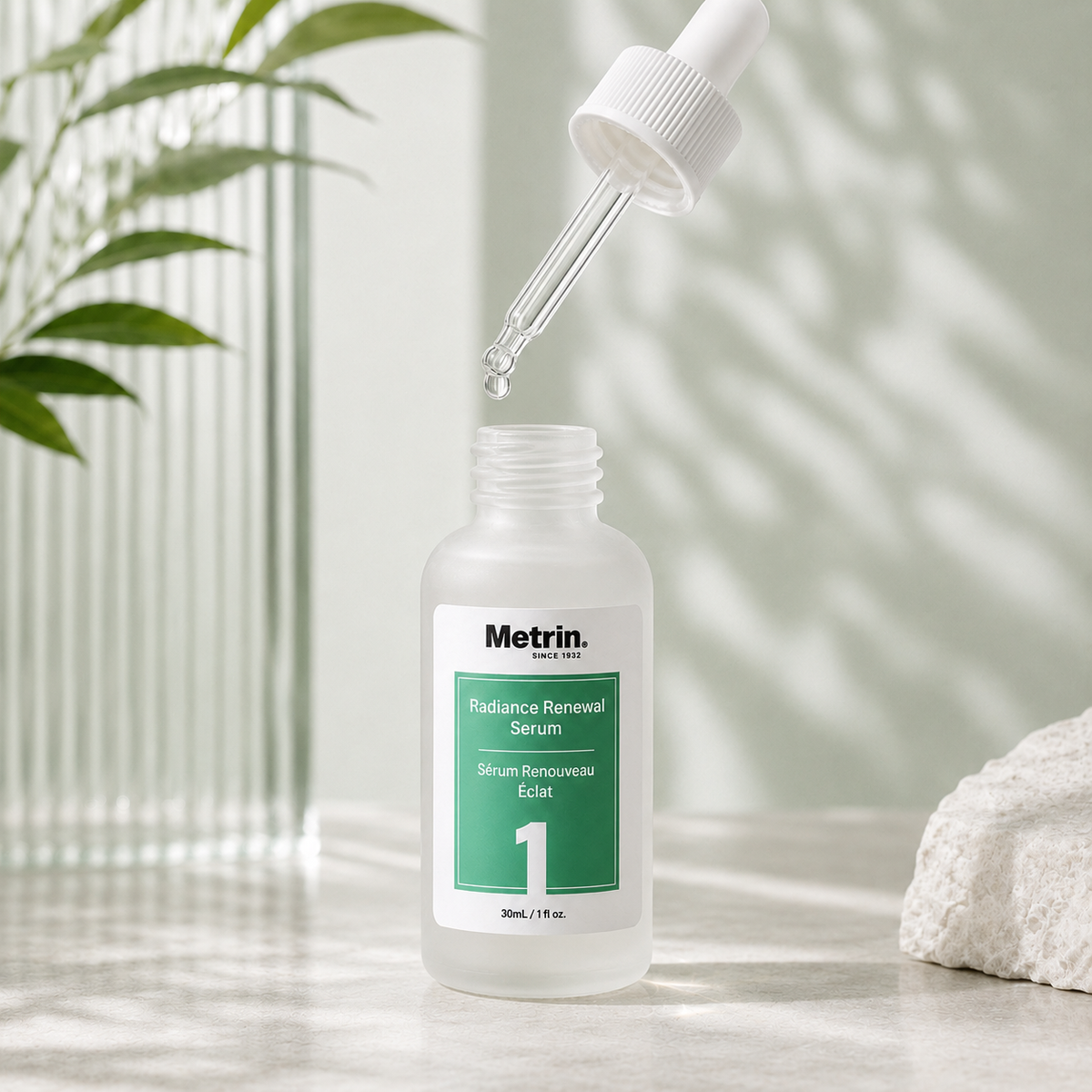
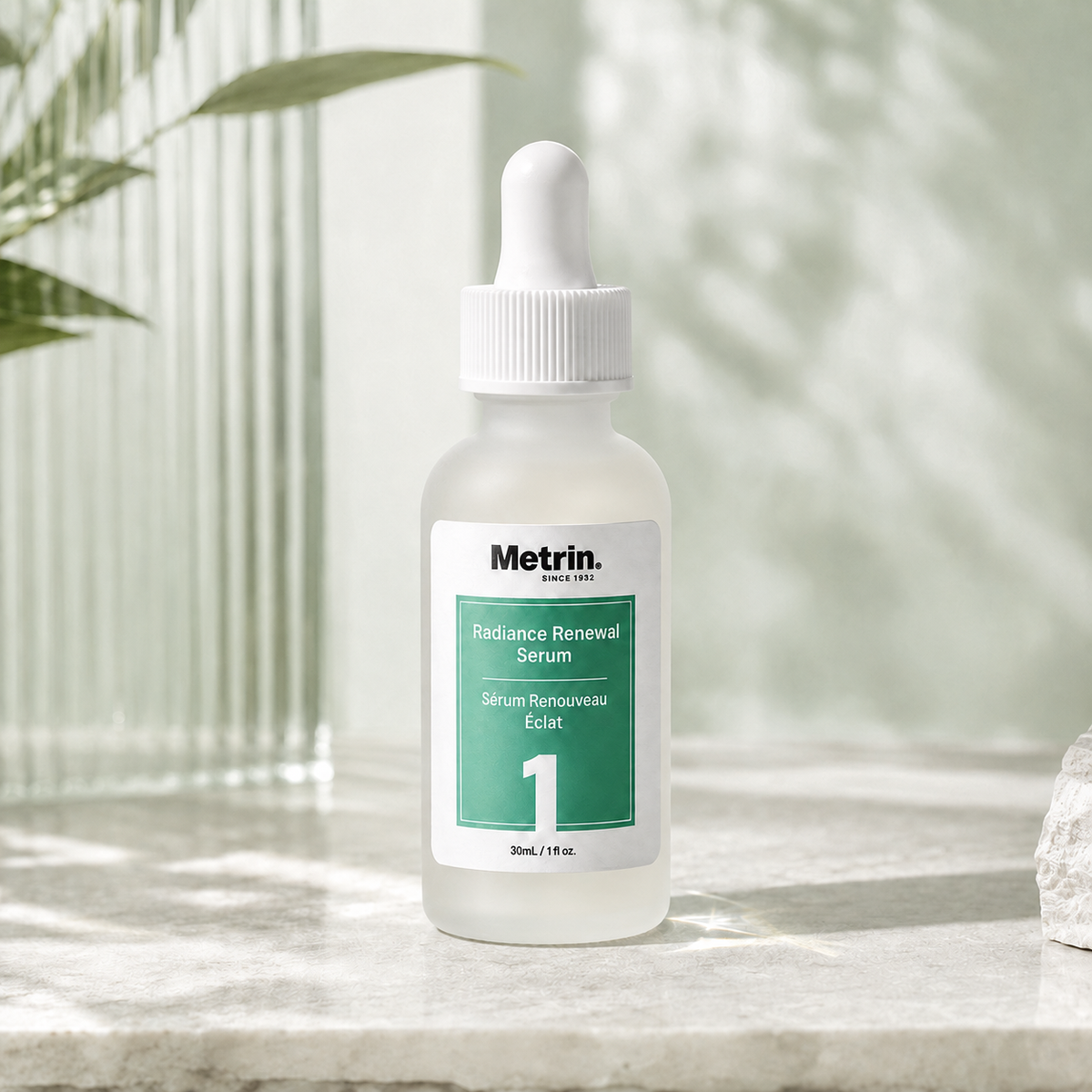
AP1 Radiance Renewal Serum renews through exfoliation.
AP2 Barrier Recovery Serum supports renewal through replenishment.
Together:
Renew. Recover. Reveal.
Your Skin Is Always Renewing — But That Renewal Changes With Time
Your epidermis is constantly changing.
New cells form in the deeper layers of the epidermis, mature as they move toward the surface and eventually become part of the outer layer that naturally sheds.
But skin does not remain biologically identical throughout life. Aging brings gradual changes to both the epidermis and dermis, including changes involving epidermal stem cells, collagen and the skin environment that supports healthy function. [1]
That helps explain why skin can begin to look and feel different in your 30s, 40s, 50s and beyond.
You may notice:
-
duller-looking skin
-
rougher or less even texture
-
more visible pigmentation
-
increasing dryness
-
fine lines becoming more noticeable
Skin Longevity reframes the goal.
Rather than trying to “reverse aging,” the objective is to support the conditions that help skin continue to function, renew and look healthy over time.
And that begins with consistency.
What Summer Can Leave Behind
Summer itself does not suddenly “age” your skin.
But cumulative ultraviolet exposure is one of the most important environmental contributors to visible photoaging. Over time, UV exposure can contribute to pigmentary changes, collagen degradation and changes in skin texture. [2]
Then, just as summer ends, the environment begins changing again.
Lower humidity and cooler temperatures can affect skin-barrier function and moisture retention, particularly as we move toward fall and winter. [8]
That makes September an ideal moment to rethink the idea of a skincare “reset.”
Your skin may benefit from additional exfoliation.
But it also needs hydration, conditioning and barrier support.
In other words:
Renewal needs balance.
Start With the Foundation: Your Daily Metrin Skincare System
The Metrin Accelerated Performance System is designed to complement — not replace — your regular Metrin Skincare System.
Your daily Metrin ritual remains the foundation of consistent care morning and evening, moving through a complete sequence of cleansing, exfoliation, hydration, protection and nourishment.
That daily rhythm matters because your skin's needs do not end when surface cells are removed.
After cleansing and exfoliation, skin also needs water, conditioning ingredients and lipids that help keep it soft, supple and comfortable.
This is the long-term Skin Longevity principle behind the Metrin ritual:
Cleanse. Exfoliate. Hydrate. Protect. Nourish. Repeat.
Then, when your skin needs something more, APS provides periodic accelerated treatment with a specific purpose.
Meet the Metrin Accelerated Performance System
The Metrin Accelerated Performance System is a two-step treatment designed to complement your regular Metrin routine when your skin would benefit from additional renewal support.
It pairs two products with two different jobs.
AP1 Radiance Renewal Serum: Renew Through Exfoliation
AP1 Radiance Renewal Serum is a 10% Glycolic Acid Exfoliating Treatment designed for periodic nighttime use.
Glycolic acid is an alpha hydroxy acid, or AHA. It helps loosen and remove accumulated surface cells that can contribute to dullness, rough texture and uneven-looking tone.
Research on AHAs supports their role in improving visible characteristics of photoaged skin, while also showing why concentration, formulation, pH, frequency of use and individual tolerance all matter. [3,4]
AP1 can help improve the appearance of:
-
dullness
-
rough or uneven texture
-
uneven-looking tone
-
visible dark spots
-
post-blemish marks
-
congestion
-
loss of radiance
Importantly, more glycolic acid is not automatically better glycolic acid.
Percentage alone does not determine how an AHA product will perform or how your skin will tolerate it.
That is why AP1 is designed as a periodic accelerated treatment, not an everyday replacement for the Metrin Skincare System.
How AP1 Fits Into Your Routine
At night, cleanse thoroughly and allow your skin to dry.
Apply a thin layer of AP1 Radiance Renewal Serum and leave it on overnight.
Use AP1 one to three nights per week according to skin tolerance.
But this is where the renewal story becomes more interesting.
Because the next morning, we do not simply exfoliate again.
We replenish.
AP2 Barrier Recovery Serum: Support Renewal Through Replenishment
After accelerated exfoliation, skin benefits from something very different from another exfoliating treatment.
It benefits from hydration.
Comfort.
Conditioning.
Barrier support.
That is the role of AP2 Barrier Recovery Serum, Metrin's Hydrating + Barrier Recovery Treatment.
AP2 does not exfoliate.
Instead, it takes a multi-ingredient approach to hydration and recovery.
Glycerin + Propanediol + Pentylene Glycol
These humectant and moisture-binding ingredients help attract and maintain moisture for hydrated, supple-feeling skin.
Bisabolol
Known for its soothing and skin-conditioning properties, bisabolol helps support skin comfort. [6]
Niacinamide
Topical niacinamide has been studied for its ability to support epidermal barrier function and moisture retention while contributing to visible skin quality. [5]
Within AP2, it helps support barrier function and a brighter, more even-looking complexion as part of the complete formulation.
Vitamin E
Vitamin E — tocopherol — is a well-established antioxidant used in dermatology and skincare formulations. [7]
Within AP2, it provides antioxidant and skin-conditioning support.
Together, these ingredients give AP2 a fundamentally different job from AP1.
AP1 removes accumulated surface cells.
AP2 replenishes hydration, soothes and conditions the skin, and supports the moisture barrier afterward.
That distinction is at the heart of APS.
Why Exfoliation Is Only Half the Renewal Story
Skincare has spent years teaching us that exfoliation equals renewal.
It is an incomplete idea.
Removing accumulated surface cells can help reveal smoother, brighter-looking skin.
But Skin Longevity asks what happens next.
What environment are you creating for the skin you have just exfoliated?
Is it hydrated?
Comfortable?
Conditioned?
Supported?
This is why APS is not simply a glycolic-acid treatment accompanied by another serum.
It is a coordinated renewal-and-recovery system.
AP1 — Renew
10% glycolic acid provides accelerated exfoliation.
AP2 — Recover
Hydration, soothing, conditioning and barrier-supporting care help replenish the skin afterward.
Together — Reveal
Smoother, brighter, more even-looking, supple and visibly radiant skin.
Two different jobs. One complete treatment.
What Happens the Morning After AP1?
The morning after an AP1 treatment, cleanse AP1 away thoroughly.
For Metrin users, follow your complete Metrin cleansing sequence.
Then apply AP2 Barrier Recovery Serum.
Once AP2 has absorbed, continue with the appropriate remaining steps of your Metrin Skincare System:
#3 Hydrate → #4 Protect → #5 Nourish
The complete rhythm becomes:
AP1: Renew through exfoliation
→ AP2: Support renewal through replenishment
→ #3 Hydrate
→ #4 Protect
→ #5 Nourish
Accelerated exfoliation has a place.
So does what comes afterward.
AP2 Isn't Only for the Morning After AP1
Because AP2 does not provide accelerated acid exfoliation, it can also be used independently when your skin would benefit from additional hydration and conditioning.
Apply it after your regular Metrin Skincare System, morning or evening, as desired.
That makes AP2 useful beyond an APS treatment cycle — particularly when weather, travel or environmental conditions leave skin feeling as though it could use additional replenishment.
AP1 and AP2 are available individually.
But when accelerated renewal is the goal, they were designed to perform complementary jobs:
AP1 renews through exfoliation.
AP2 supports renewal through replenishment.
Why More Exfoliation Isn't Necessarily Better
One of the most persistent assumptions in skincare is that if a little exfoliation is good, more must be better.
Skin doesn't work that way.
AHAs can cause temporary tingling and, when overused or poorly tolerated, may cause redness, burning, excessive peeling or discomfort. Concentration and formulation matter, but so does frequency. [4]
Think of AP1 as a periodic treatment, not a challenge to see how much your skin can tolerate.
If glycolic acid is new to you, begin gradually.
Pay attention to how your skin responds.
And remember: the objective is not maximum exfoliation.
It is effective renewal while maintaining skin comfort and balance.
One Rule Doesn't Change With the Season: Protect Your Skin From the Sun
September may mark the end of summer.
It does not mark the end of ultraviolet exposure.
Sun protection becomes particularly important when using an AHA such as glycolic acid. FDA guidance states that AHA-containing cosmetics may increase skin sensitivity to the sun and recommends sunscreen, protective clothing and limiting sun exposure while using the product and for one week afterward. [9]
So while APS can help improve the appearance of dullness, roughness and uneven-looking tone you may notice after summer, it should always be paired with sensible daytime sun protection.
Think of it as preserving tomorrow's skin while caring for today's.
Real Skin Longevity Is Built Over Years
The idea of accelerated renewal can sound exciting.
But acceleration works best when it has a strong foundation beneath it.
That foundation is consistency.
Long-time Metrin user Cynthia P. puts it simply:
“I have used Metrin for 30 years. I attribute my healthy skin to daily use of the five step routine.”
And Donna D., a Metrin customer for more than four decades, describes that same long-term relationship another way:
“My NOT SO SECRET is Metrin products… which I have used for 40+ years.”
Neither story is about a one-night transformation.
They are about something much more closely aligned with Skin Longevity:
what happens when good skincare becomes a ritual you keep.
APS can accelerate one part of that process when your skin needs it.
The daily Metrin Skincare System is what surrounds that acceleration with consistent care.
Your September Skin Renewal Reset
If summer has left your complexion looking duller, rougher or less even, resist the urge to rebuild your entire skincare shelf.
Return to your daily routine.
Use your complete Metrin Skincare System consistently morning and evening.
Accelerate selectively.
Introduce AP1 Radiance Renewal Serum one to three evenings per week according to your skin's tolerance.
Complete the renewal story.
The following morning, use AP2 Barrier Recovery Serum to replenish hydration, soothe and condition the skin, and support the moisture barrier.
Return to Hydrate, Protect and Nourish.
Continue with #3, #4 and #5.
Protect against UV exposure.
Keep appropriate sun protection part of your daytime routine throughout the year.
And most importantly:
Give your skin time.
Skin Longevity isn't built through endless correction.
It is built through rhythm.
Consistency when your skin is doing well.
Thoughtful acceleration when it needs more.
And replenishment after you ask it to do more.
Renew. Recover. Reveal.
Frequently Asked Questions About Skin Renewal and APS
What percentage of glycolic acid is in AP1?
AP1 Radiance Renewal Serum contains 10% glycolic acid.
It is designed for nighttime use one to three times per week according to skin tolerance.
Is 10% glycolic acid strong?
A 10% concentration provides meaningful at-home AHA exfoliation, but percentage alone does not tell you how a glycolic-acid product will perform or how your skin will tolerate it.
Formulation, pH, frequency of use and individual skin tolerance all matter. [4]
What is the difference between AP1 and AP2?
They perform different jobs.
AP1 renews through exfoliation.
AP2 supports renewal through replenishment.
AP1 helps remove accumulated surface cells. AP2 helps replenish hydration, soothe and condition the skin, and support the moisture barrier afterward.
References
-
Quan, T. (2023). “Molecular insights of human skin epidermal and dermal aging.” Journal of Dermatological Science, 112(2), 48–53. doi: 10.1016/j.jdermsci.2023.08.006.
-
Tsai, J., & Kang, S. (2026). “Photoaging: Update on Pathogenesis, Prevention, and Treatment.” Annals of Dermatology, 38(3), 167–176. doi: 10.5021/ad.26.006.
-
Ditre, C. M., Griffin, T. D., Murphy, G. F., Sueki, H., Telegan, B., Johnson, W. C., Yu, R. J., & Van Scott, E. J. (1996). “Effects of alpha-hydroxy acids on photoaged skin: A pilot clinical, histologic, and ultrastructural study.” Journal of the American Academy of Dermatology, 34(2 Pt 1), 187–195. doi: 10.1016/S0190-9622(96)80110-1.
-
Almeman, A. A. (2024). “Evaluating the Efficacy and Safety of Alpha-Hydroxy Acids in Dermatological Practice: A Comprehensive Clinical and Legal Review.” Clinical, Cosmetic and Investigational Dermatology, 17, 1661–1685. doi: 10.2147/CCID.S453243.
-
Gehring, W. (2004). “Nicotinic acid/niacinamide and the skin.” Journal of Cosmetic Dermatology, 3(2), 88–93. doi: 10.1111/j.1473-2130.2004.00115.x.
-
Bader Eddin, L., Jha, N. K., Goyal, S. N., Agrawal, Y. O., Subramanya, S. B., Bastaki, S. M. A., & Ojha, S. (2022). “Health Benefits, Pharmacological Effects, Molecular Mechanisms, and Therapeutic Potential of α-Bisabolol.” Nutrients, 14(7), 1370. doi: 10.3390/nu14071370.
-
Ramos-E-Silva, M., Camargo, C., Cavalcante, R., & Carneiro, S. (2026). “Vitamin E in dermatology.” Clinics in Dermatology, 44(2), 257–263. doi: 10.1016/j.clindermatol.2026.02.009.
-
Engebretsen, K. A., Johansen, J. D., Kezic, S., Linneberg, A., & Thyssen, J. P. (2016). “The effect of environmental humidity and temperature on skin barrier function and dermatitis.” Journal of the European Academy of Dermatology and Venereology, 30(2), 223–249. doi: 10.1111/jdv.13301.
-
U.S. Food and Drug Administration. (2005). Guidance for Industry: Labeling for Cosmetics Containing Alpha Hydroxy Acids. U.S. Food and Drug Administration.
#SkinRenewal #SkinLongevity #GlycolicAcid #AHASkincare #BarrierSupport #SkinBarrier #FallSkincare #SeptemberSkincare #UnevenSkinTone #DullSkin #SkinExfoliation #HealthySkin #MetrinAPS #MetrinSkincare