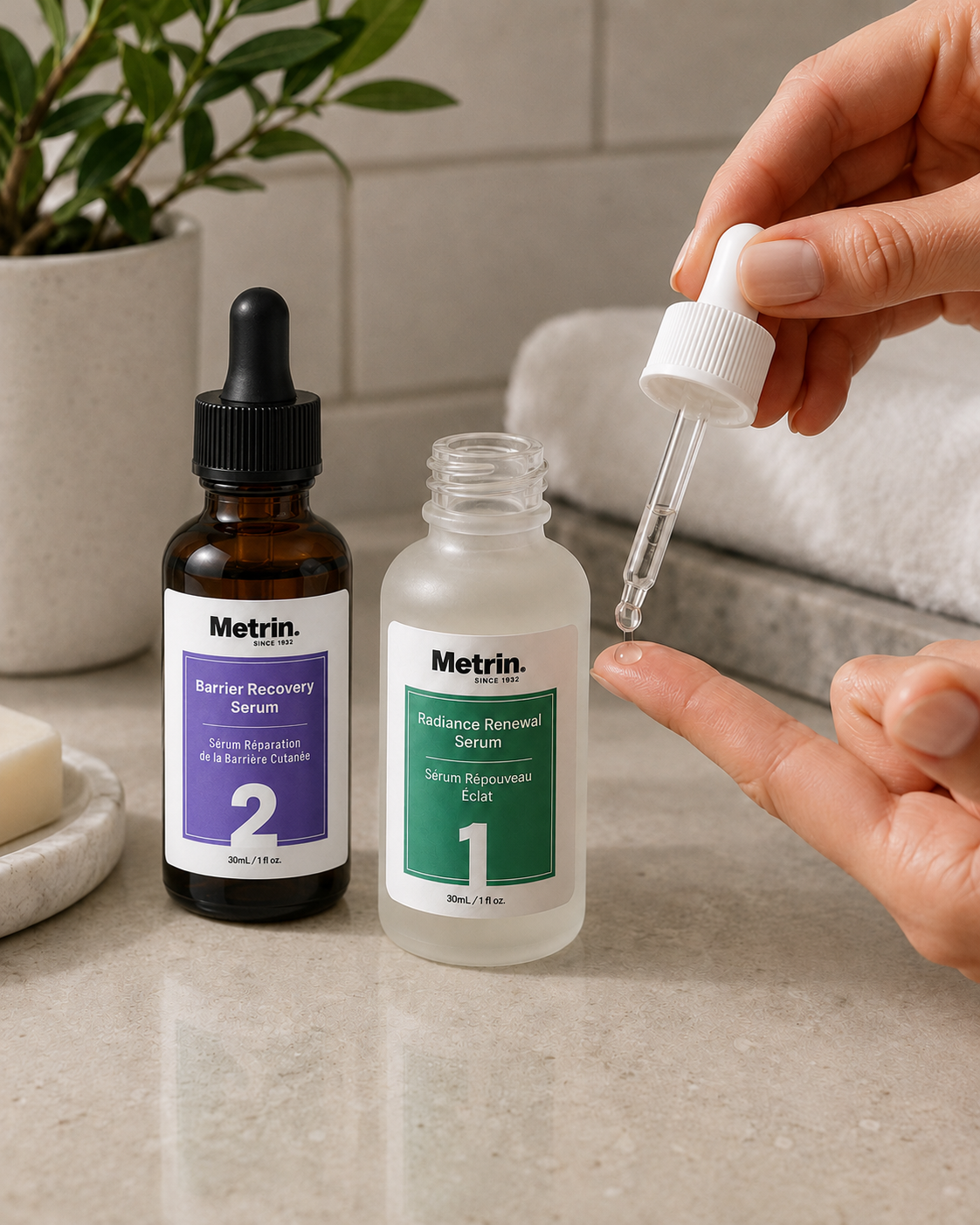
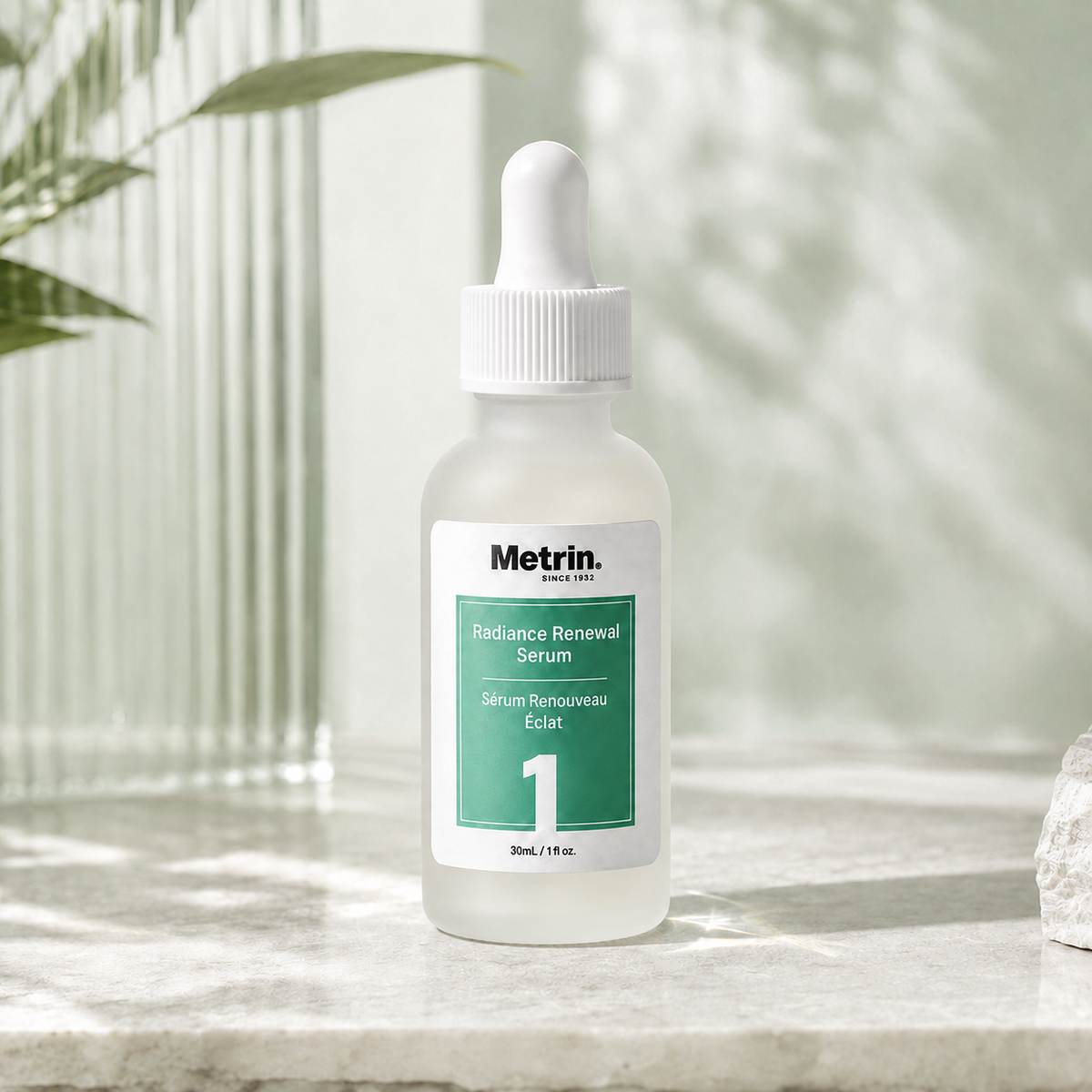
The goal of exfoliation isn’t to peel your skin. It’s to help aging skin renew more intelligently.
There is something satisfying about freshly exfoliated skin. It feels smoother. It catches the light differently. Makeup seems to sit better.
But those immediate surface changes are only part of what makes glycolic acid interesting—especially as skin gets older.
Glycolic acid has been used in dermatology and cosmetic skincare for decades, and research has explored effects ranging from surface exfoliation to changes associated with photoaged skin. Some studies have even found changes in collagen density and collagen-related gene activity after sustained glycolic acid or alpha hydroxy acid use.[1][2]
That does not mean that every glycolic acid product “builds collagen,” or that stronger acids automatically produce younger-looking skin.
The more useful story is subtler.
To understand what glycolic acid can—and cannot—do for aging skin, we first need to understand what is happening to the skin itself.
What Happens to Skin Renewal as We Age?
Your skin is never static.
New cells form within the epidermis, gradually move upward, mature, and eventually become part of the stratum corneum—the outermost layer of skin composed largely of flattened cells called corneocytes.
Those surface cells are eventually shed through a natural process known as desquamation.
With age, this beautifully coordinated process becomes less efficient. Epidermal turnover slows, while age-related changes affect skin structure, barrier function and the deeper dermal matrix, including a progressive loss and fragmentation of collagen.[3][4]
Then there is the accumulated effect of sunlight.
Ultraviolet exposure contributes significantly to photoaging—the wrinkles, uneven pigmentation and other visible changes associated with years of sun exposure.[5]
So when skin begins to look duller, rougher or less even with age, you are not imagining it.
The renewal machinery itself is changing.
That is where exfoliation becomes interesting.
What Does Glycolic Acid Actually Do?
Glycolic acid belongs to a family of ingredients called alpha hydroxy acids, or AHAs.
Rather than physically scrubbing cells away, glycolic acid helps reduce the cohesion between cells within the outer stratum corneum, encouraging accumulated surface cells to shed more readily.
In a human study examining glycolic acid’s effect on the stratum corneum, researchers found enhanced breakdown of the structures that help hold outer corneocytes together, promoting desquamation without compromising the skin-barrier structures under the specific conditions studied.[6]
In simpler language:
Glycolic acid helps loosen what the skin is ready to let go of.
That can help explain some of its most familiar visible benefits:
-
smoother-feeling skin
-
improved appearance of rough texture
-
a brighter, less dull-looking complexion
-
more even-looking skin tone
-
softening of the appearance of fine lines
But that still leaves the bigger question.
Does Glycolic Acid Really Affect Collagen?
This is where skincare marketing often races ahead of the science.
Collagen lives primarily in the dermis, beneath the epidermis. Simply removing dead surface cells is not the same thing as producing new dermal collagen.
Yet glycolic acid research has produced some genuinely interesting findings.
In one six-month human study of photoaged skin, treatment with alpha hydroxy acids was associated with an approximately 25% increase in total skin thickness. Researchers reported a thicker epidermis as well as changes within the papillary dermis, including increased collagen density and improved elastic-fiber quality.[1]
Another controlled human study using 20% glycolic acid over three months found increased type I collagen gene expression and increased hyaluronic acid in treated skin compared with vehicle-treated skin.[2]
Laboratory research has also found that glycolic acid can influence cultured human fibroblast activity and collagen synthesis under experimental conditions.[7]
These findings help explain why glycolic acid has long been studied in connection with photoaged skin.
But there is an important distinction:
Research showing collagen-related changes under particular concentrations, formulations and treatment conditions does not mean every cosmetic glycolic acid product will reproduce those same results.
The studies cited here did not test Metrin’s Accelerated Performance System and should not be interpreted as clinical evidence of identical effects from a specific consumer formulation.
That is why a more precise description is useful:
Glycolic acid supports a renewal process that can benefit the visible surface of aging skin, while research under specific conditions also suggests effects on processes associated with dermal remodeling.
That is more scientifically defensible—and ultimately more interesting—than simply saying, “exfoliation builds collagen.”
Exfoliation and Collagen Are Different Parts of the Aging Story
Think of your skin as a house that is continually maintaining itself.
The epidermis is the part most directly exposed to daily life. Cells form, mature, protect and eventually need to leave.
The dermis underneath provides much of the structural framework, including its collagen-rich extracellular matrix.
Aging affects both.
Good exfoliation helps the surface renewal process work more efficiently.
Collagen preservation and renewal concern the deeper structural environment of the skin.
They are connected, but they are not identical.
This is also why caring for collagen should never be reduced to a single ingredient.
Hydration, barrier support, protection from UV exposure and consistent skincare all contribute to maintaining healthier-looking skin over time.
For a broader look at that idea, see Unlock the Secret to Ageless Skin: Collagen Banking with Metrin.
When More Exfoliation Becomes Less Intelligent
If glycolic acid is beneficial, it can be tempting to assume that a stronger acid, a more dramatic peel or more frequent exfoliation must be even better.
Skin does not work that way.
Over-exfoliation can lead to dryness, redness and irritation. The American Academy of Dermatology specifically advises choosing an exfoliation method appropriate for your skin and notes that the more aggressive the exfoliation, the less frequently it generally needs to be performed.[8]
The lesson is simple:
Good exfoliation is controlled exfoliation.
The goal is not redness.
It is not burning.
It is not seeing how much skin you can make peel away.
It is helping accumulated surface cells release while respecting the skin underneath.
That becomes especially important as skin grows naturally drier and more prone to changes in barrier function with age.[3][4]
Why Hydration Matters After Exfoliation
Removing accumulated surface cells can make skin feel exceptionally smooth, but exfoliation is only one half of a well-designed renewal strategy.
The other half is what happens next.
As skin ages, changes in its barrier and water-binding capacity can contribute to greater dryness.[3]
That means an intelligent exfoliation routine should be paired with replenishment rather than simply more treatment.
Humectants can help attract and retain water. Conditioning ingredients can improve softness and comfort. The rest of your skincare routine can then help maintain hydration and support the skin barrier.
This is why we think about exfoliation in two complementary phases:
Renew. Then replenish.
One More Thing Glycolic Acid Users Should Know: Sun Protection
Freshly exfoliated skin and unprotected UV exposure are not a wise combination.
The U.S. Food and Drug Administration notes that alpha hydroxy acids can temporarily increase skin sensitivity to ultraviolet radiation. Its guidance recommends sunscreen, protective clothing and limited sun exposure while using AHA-containing products and for a week afterward.[9]
That matters because chronic UV exposure is itself one of the most important contributors to photoaging.[5]
So if your goal is healthier-looking skin over decades rather than simply smoother skin tomorrow morning, sun protection belongs beside exfoliation—not as an afterthought.
How Metrin Applies the Principle: Renew, Then Replenish
This brings us to the Metrin Accelerated Performance System (APS).
Rather than treating glycolic acid as a stand-alone “miracle active,” APS organizes exfoliation and post-exfoliation care into two complementary stages.
Accelerated Performance 1 (AP1) — Revitalizing Glycolic Complex: Renew Through Exfoliation
AP1 is Metrin’s glycolic acid treatment.
Used periodically at night following cleansing, it is designed to provide more intensive exfoliation than the gentle daily renewal supported by the Metrin Skincare System.
Its role is deliberately focused:
AP1 renews through exfoliation.
By helping accumulated surface cells shed, AP1 supports smoother-looking texture, improved radiance and the skin’s ongoing renewal process.
Accelerated Performance 2 (AP2) — Reactivating Serum: Support Renewal Through Replenishment
The next morning, after AP1 has been removed through cleansing, AP2 becomes the second half of the process.
Its purpose is different.
AP2 supports renewal through replenishment.
The Reactivating Serum provides hydration and conditioning ingredients—including glycerin, aloe vera, panthenol and allantoin—to help replenish moisture and comfort the skin following exfoliation.
From there, the regular Metrin Skincare System continues the process of hydration, protection and nourishment.
This distinction matters.
The idea is not:
exfoliate → exfoliate more → exfoliate again.
It is:
renew → replenish → return to balanced daily care.
That is what makes exfoliation part of a skincare system rather than simply another active ingredient.
“My skin seems so smooth and even textured… I am 63 and constantly get compliments on my skin.” — Barbara D., Metrin Accelerated Performance System customer
How Often Should You Use Glycolic Acid?
There is no universal exfoliation schedule appropriate for every skin type and every formula.
With Metrin’s Accelerated Performance System, AP1 is designed for periodic use—typically one to three nights per week according to product directions and individual skin needs—rather than indiscriminate daily intensification.
If your skin feels persistently tight, irritated, unusually dry or uncomfortable, that is not evidence that a product is “working harder.”
It is a reason to reassess.
Skin longevity is built through consistency, not punishment.
For step-by-step guidance, see How to Incorporate the Accelerated Performance System into Your Skincare Routine and How to Hydrate, Nourish and Protect Your Skin After Deep Exfoliation.
For a broader look at how APS fits into skin renewal, see How to Accelerate Your Skin’s Renewal.
Frequently Asked Questions About Glycolic Acid and Aging Skin
Does glycolic acid produce collagen?
Human and laboratory studies have found collagen-related changes after glycolic acid or AHA treatment under specific experimental conditions, including increased collagen density, collagen-gene expression and collagen synthesis.[1][2][7]
However, those findings should not be interpreted to mean that every glycolic acid cosmetic automatically produces new collagen. Concentration, formulation, pH, frequency and treatment conditions all matter.
Does exfoliating make skin thinner?
Proper chemical exfoliation acts primarily on the outer stratum corneum rather than simply “wearing away” living skin. In one longer-term clinical AHA study, treatment was actually associated with increased epidermal and overall skin thickness under the conditions studied.[1]
Is stronger glycolic acid always better?
No.
The concentration of glycolic acid is only one part of how a formula behaves. pH, product vehicle, frequency of use, skin condition and the rest of your routine also matter.
More aggressive exfoliation generally requires less frequent use, and excessive exfoliation can result in redness and irritation.[8]
Can glycolic acid help the appearance of wrinkles?
AHAs are used in skincare to improve skin texture and smooth the appearance of fine lines and surface wrinkles.[9] Controlled clinical research has also documented improvements in photoaged skin after sustained AHA use.[1]
That does not mean glycolic acid can erase every wrinkle or reverse all of the structural changes associated with aging.
Should I replenish hydration after glycolic acid?
Yes.
Exfoliation should be balanced with appropriate hydration and barrier-supportive care. The American Academy of Dermatology also recommends moisturizing after exfoliation to help keep skin hydrated.[8]
Within the Metrin APS routine, AP2 is specifically used following AP1 to provide the replenishment stage of the system.
Exfoliate for the Skin You Want to Keep
The best skincare usually becomes clearer when we stop asking one ingredient to do everything.
Glycolic acid is a very good example.
Its most immediate job is exfoliation.
By helping the outer surface of the skin shed accumulated cells more efficiently, glycolic acid can improve smoothness, brightness and texture. Research also suggests that under particular conditions its effects can extend beyond surface exfoliation into processes associated with photoaged skin and dermal remodeling.
That makes glycolic acid an interesting ingredient.
But not a magical one.
Healthy-looking aging skin still depends on the whole environment: renewal, hydration, barrier support, UV protection, nourishment and consistency.
Perhaps that is the real meaning of intelligent exfoliation.
Not doing the most.
Doing enough—and knowing what your skin needs next.
Ready to Add Accelerated Renewal to Your Routine?
If your skin is beginning to look dull, uneven or rough—or you are wondering whether glycolic acid belongs in your routine—explore the Metrin Accelerated Performance System and discover how AP1 renewal and AP2 replenishment work together.
Not sure whether accelerated exfoliation is right for your skin?
Tell us about your concerns through Metrin’s FREE Skincare Consultation and our team can help you determine how to integrate exfoliation into your existing routine.
References
-
Ditre, C. M., Griffin, T. D., Murphy, G. F., Sueki, H., Telegan, B., Johnson, W. C., Yu, R. J., & Van Scott, E. J. (1996). Effects of alpha-hydroxy acids on photoaged skin: A pilot clinical, histologic, and ultrastructural study. Journal of the American Academy of Dermatology, 34(2 Pt 1), 187–195. https://doi.org/10.1016/S0190-9622(96)80110-1
-
Bernstein, E. F., Lee, J., Brown, D. B., Yu, R., & Van Scott, E. (2001). Glycolic acid treatment increases type I collagen mRNA and hyaluronic acid content of human skin. Dermatologic Surgery, 27(5), 429–433. https://doi.org/10.1046/j.1524-4725.2001.00234.x
-
Farage, M. A., Miller, K. W., Elsner, P., & Maibach, H. I. (2013). Characteristics of the aging skin. Advances in Wound Care, 2(1), 5–10. https://doi.org/10.1089/wound.2011.0356
-
Quan, T. (2023). Molecular insights of human skin epidermal and dermal aging. Journal of Dermatological Science, 112(2), 48–53. https://doi.org/10.1016/j.jdermsci.2023.08.006
-
Tsai, J., & Kang, S. (2026). Photoaging: Update on pathogenesis, prevention, and treatment. Annals of Dermatology, 38(3), 167–176. https://doi.org/10.5021/ad.26.006
-
Fartasch, M., Teal, J., & Menon, G. K. (1997). Mode of action of glycolic acid on human stratum corneum: Ultrastructural and functional evaluation of the epidermal barrier. Archives of Dermatological Research, 289(7), 404–409. https://doi.org/10.1007/s004030050212
-
Kim, S. J., & Won, Y. H. (1998). The effect of glycolic acid on cultured human skin fibroblasts: Cell proliferative effect and increased collagen synthesis. Journal of Dermatology, 25(2), 85–89. https://doi.org/10.1111/j.1346-8138.1998.tb02355.x
-
American Academy of Dermatology Association. How to safely exfoliate at home. Updated February 6, 2026. Accessed August 25, 2026.
-
U.S. Food and Drug Administration. Alpha Hydroxy Acids. Accessed August 25, 2026.
#GlycolicAcid #Exfoliation #SkinRenewal #Collagen #CollagenCare #AgingSkin #MatureSkin #SkinLongevity #AntiAgingSkincare #HealthySkin #ChemicalExfoliation #MetrinSkincare #AcceleratedPerformanceSystem